3 – THE AMERICAN
During the Second World War, unlike their Italian and British counterparts who operated in the Mediterranean and North Sea, American frogmen were primarily engaged in support of various war missions in the Pacific area against Japanese forces. The 1951 American film “Le Rane del Mare” (see Fig. 113) with original English title "The Frogmen" (see Fig. 114), is dedicated to these stories. Directed by Lloyd Bacon, the movie starred Richard Widmark (Commander John Lawrence), Dana Andrews (Jake Flannigan), Gary Merrill (Commander Pete Vincent), Robert Wagner (Franklin), Jeffrey Hunter (Pappy Creighton), Warren Stevens (Hodges), and Harvey Lembeck (Marwin W. Mikowsky).
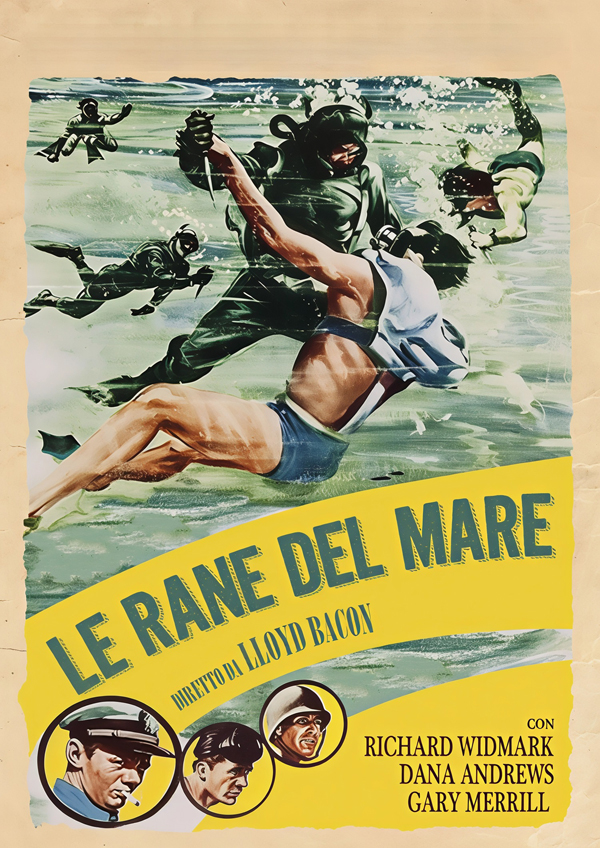
fig. 113 |
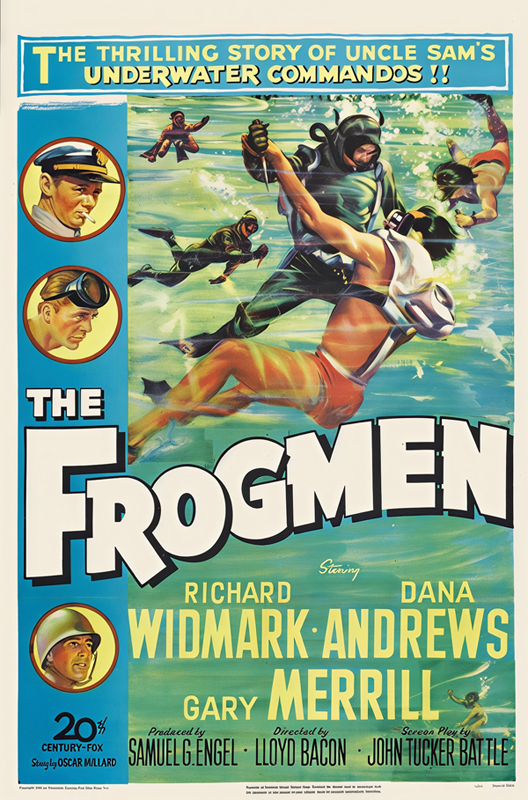
fig. 114 |
The name of this special team of US Navy frogmen was Underwater Demolition Team (UDT). They were amphibious units created by the United States Navy during the Second World War to carry out specialized missions to support the invasion forces of the US Navy Marines (see Figs. 115 and 116). The UDTs were the predecessors of the current US Navy SEALs.
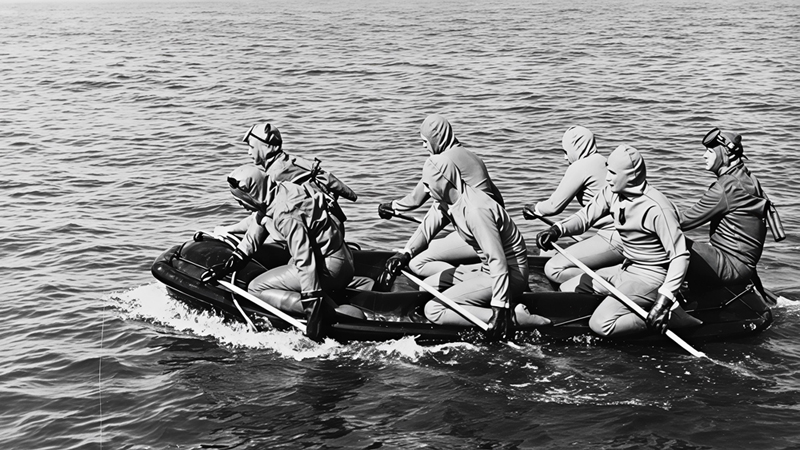
fig. 115 |
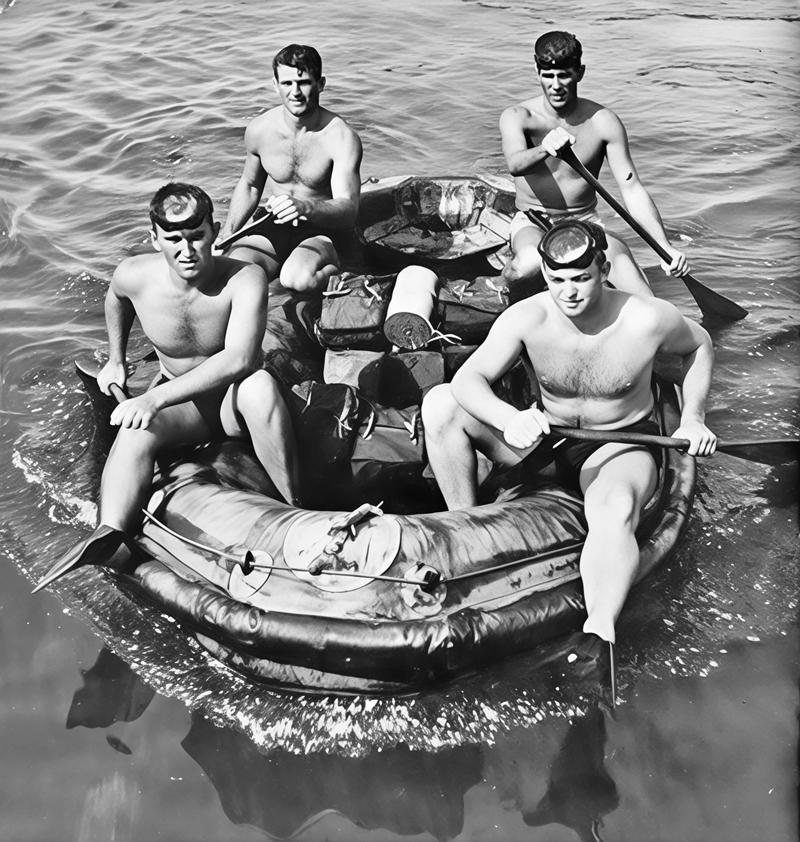
fig. 116 |
Their main functions during the Second World War consisted in the reconnaissance, identification and subsequent demolition and removal of natural obstacles or underwater defensive installations, set up by enemy forces to prevent or slow down the landings of amphibious vehicles (see Figs. 117 and 118).
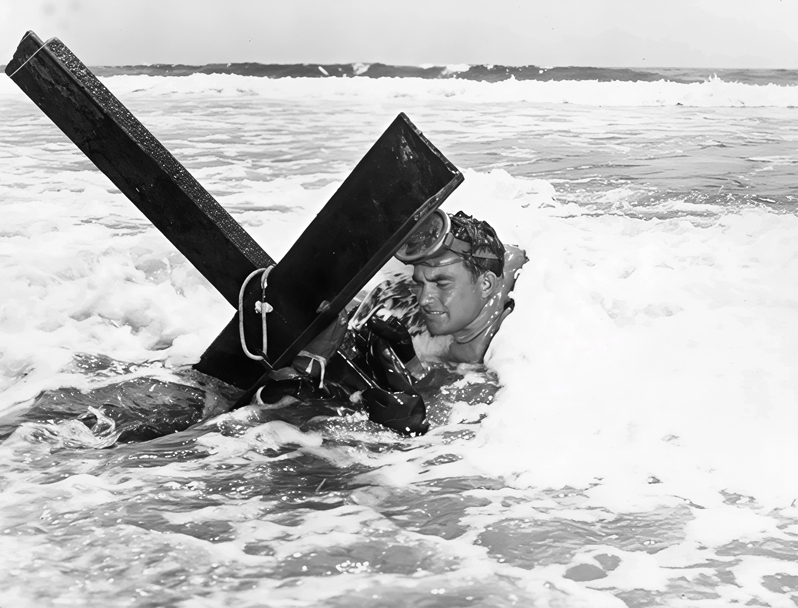
fig. 117 |
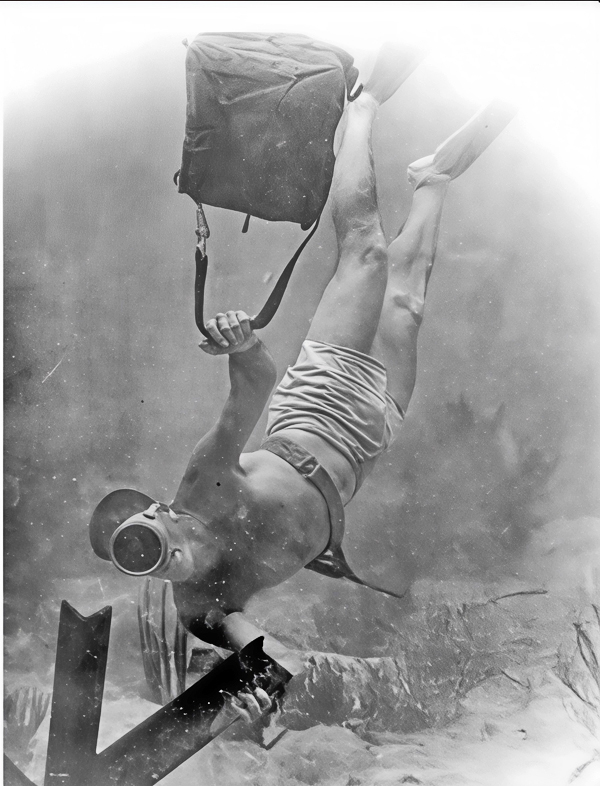
fig. 118 |
During the war, their diving equipment was minimal and rather basic, but after the war, it was significantly enriched and completed, allowing them to strengthen and expand their operational capabilities. To this scope, the UDTs were directly involved in testing new materials and equipment, providing support to the US Navy's experimental organization, the NEDU (Navy Experimental Diving Unit). Figures 119 and 120 show some examples of tests conducted on two Italian-made oxygen rebreather models, the Cressi CF-49 (specially modified with the addition of a second lung placed behind the operator's neck) and the Pirelli Poseidon.
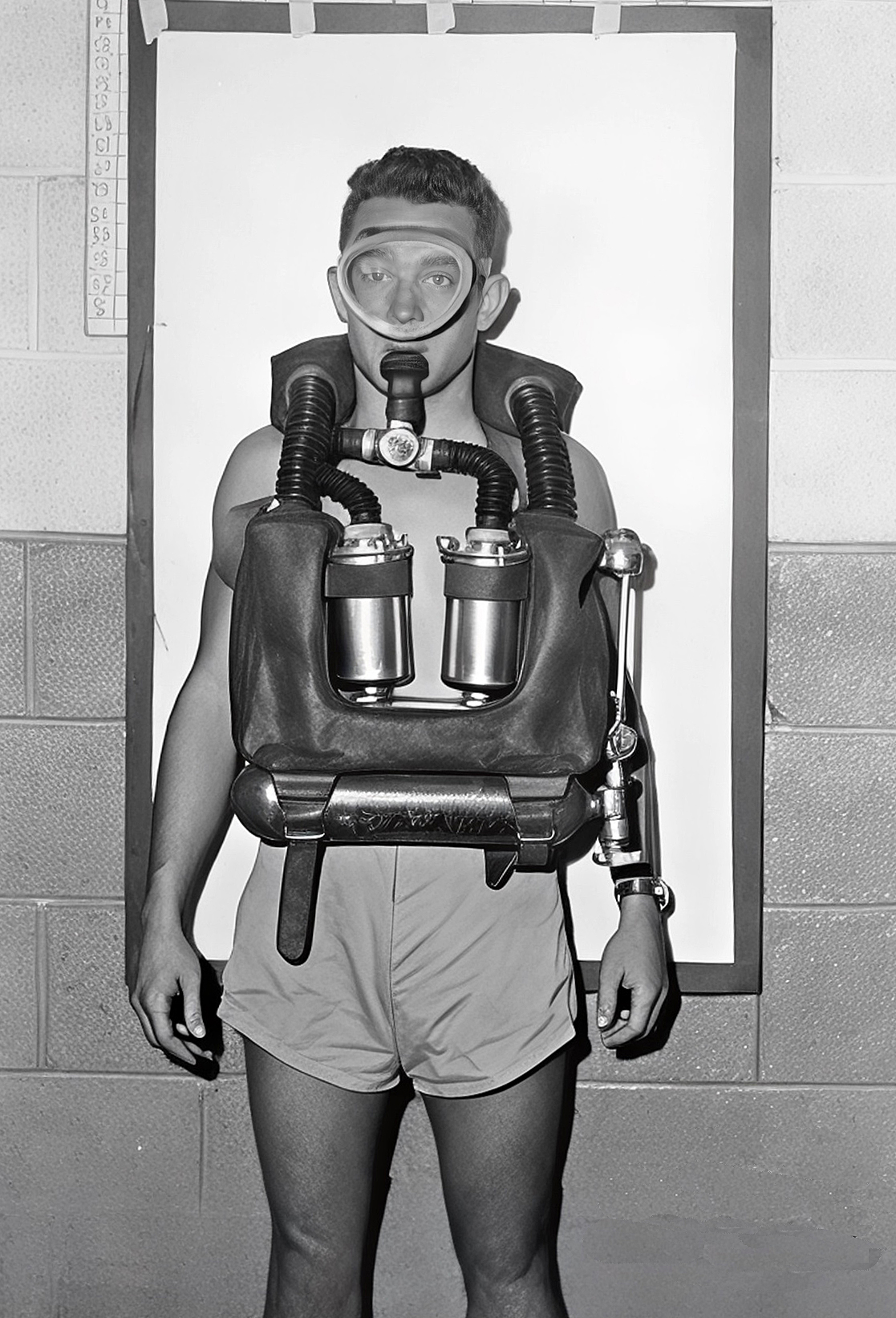
fig. 119 |
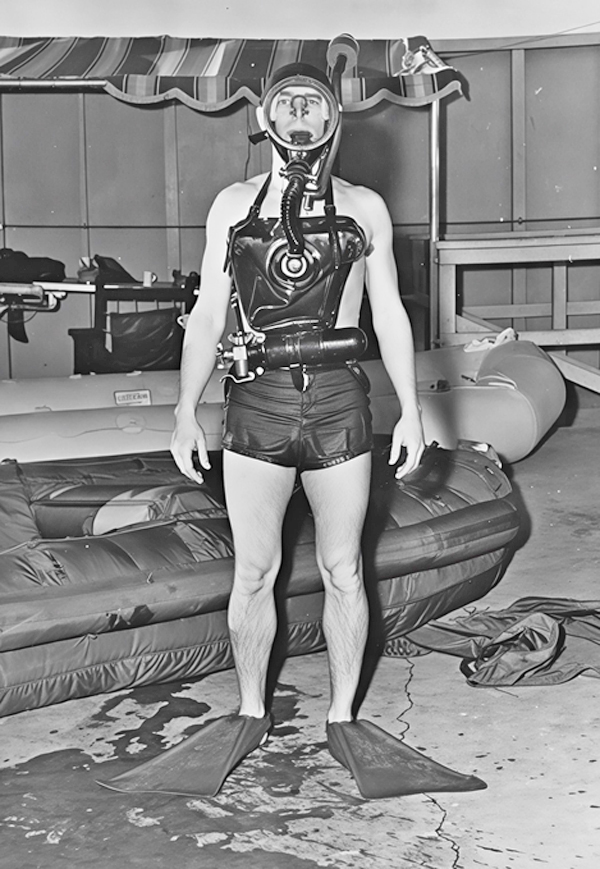
fig. 120 |
Following the enhancement of their underwater operational capabilities, the UDTs began to be considered an elite organization with more tactical duties during the Korean and Vietnam wars. They were pioneers and innovators in various fields, including underwater demolitions, closed-circuit apparatus diving, deep-infiltration missions into enemy territory, rivers warfare tactics, and midget submarine operations. They were also responsible for ensuring the recovery of space vehicles and their crews after splashdowns as part of spaceflight programs such as Mercury, Gemini, and Apollo. Later, the commando specialty was added to their training program, making them the forerunners of the U.S. Navy's SEAL program, a military organization that still exists today.
The UDTs engaged in Pacific operations during the Second World War were equipped with minimal gear, as shown in Fig. 121. This consisted of simple swim trunks, a small round mask (see Fig. 122), and a pair of Owen Churchill fins. The lack of any thermal protection in the water was justified by the temperature conditions typical of Pacific missions, which often occurred on tropical island shores.
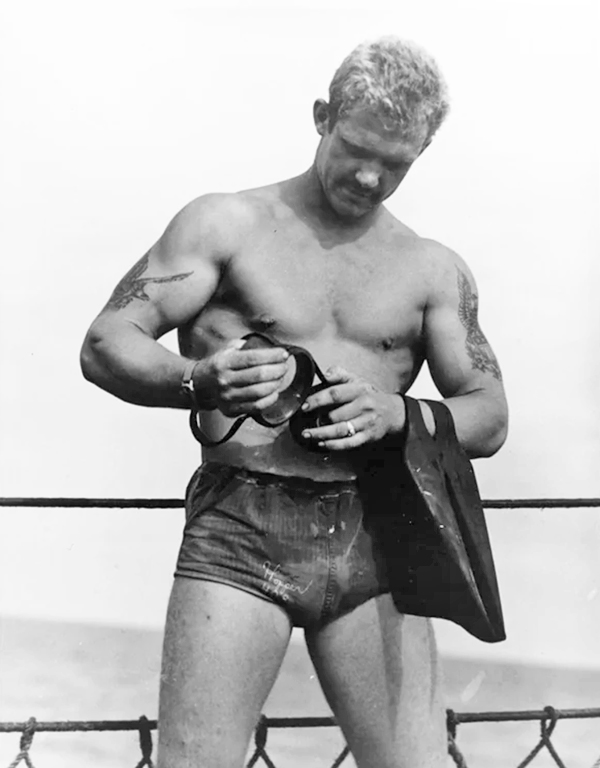
fig. 121 |
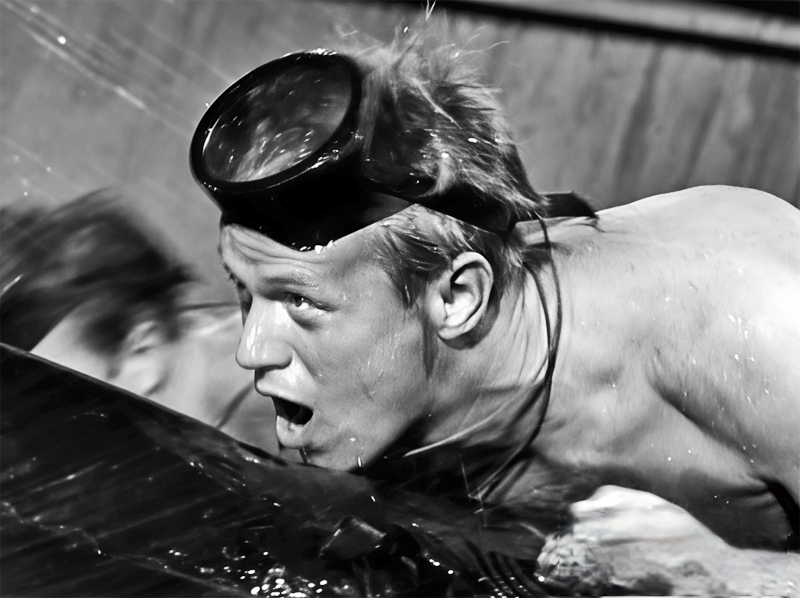
fig. 122 |
Although we have found no conclusive evidence, these masks were probably manufactured for the US Navy by the Californian company Sea-Net Manufacturing Co. This company was founded in Los Angeles in the late 1930s by Lawrence Palmer Romano (of Italian origins) and had begun producing fishing equipment (e.g., nets, ropes, traps, etc.). Following strong demand from early spearfishing divers in California, including Hal Messinger and Frank Rodecker (see Fig. 123), who in addition to being divers were also coast guards and surfers, the company began manufacturing spearfishing equipment (harpoons, masks and fins). The basic model mask produced for the US Navy was probably the Sea-Dive, which was later improved after the war and marketed under the name Deluxe Sea-Dive (see Fig. 124
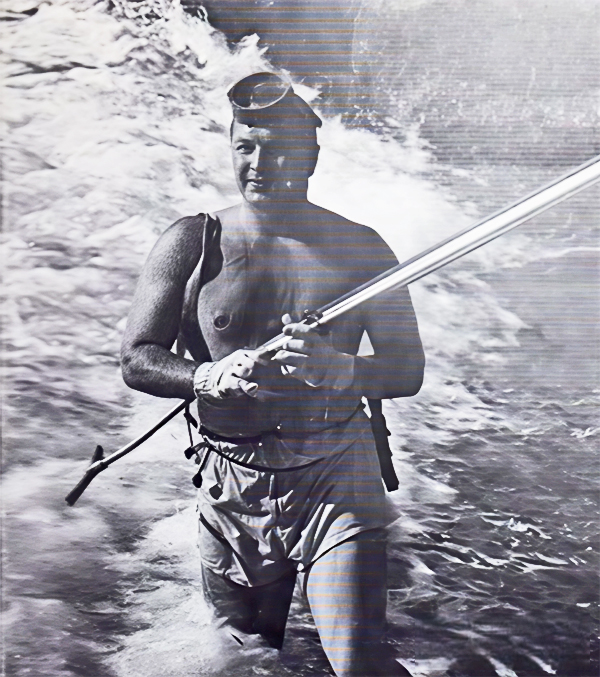
fig. 123 |
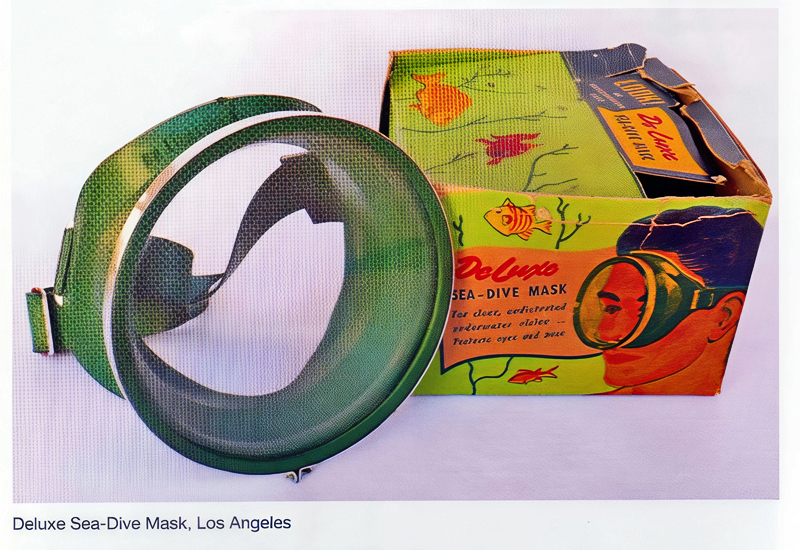
fig. 124 |
The Sea-Net Manufacturing Co., some advertisements for which are shown in Figs. 125 and 126, remained in business until the mid-1950s.
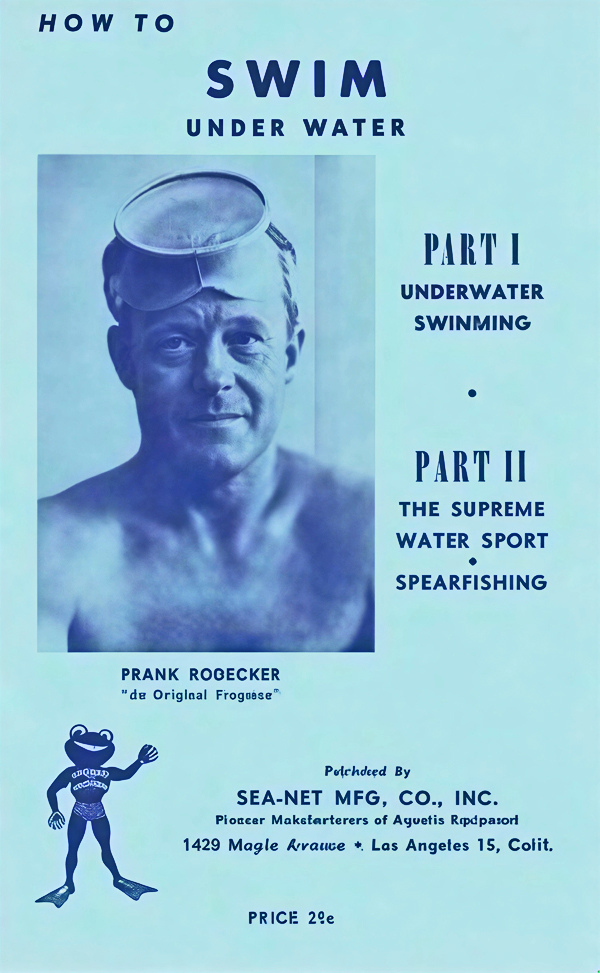
fig. 125 |
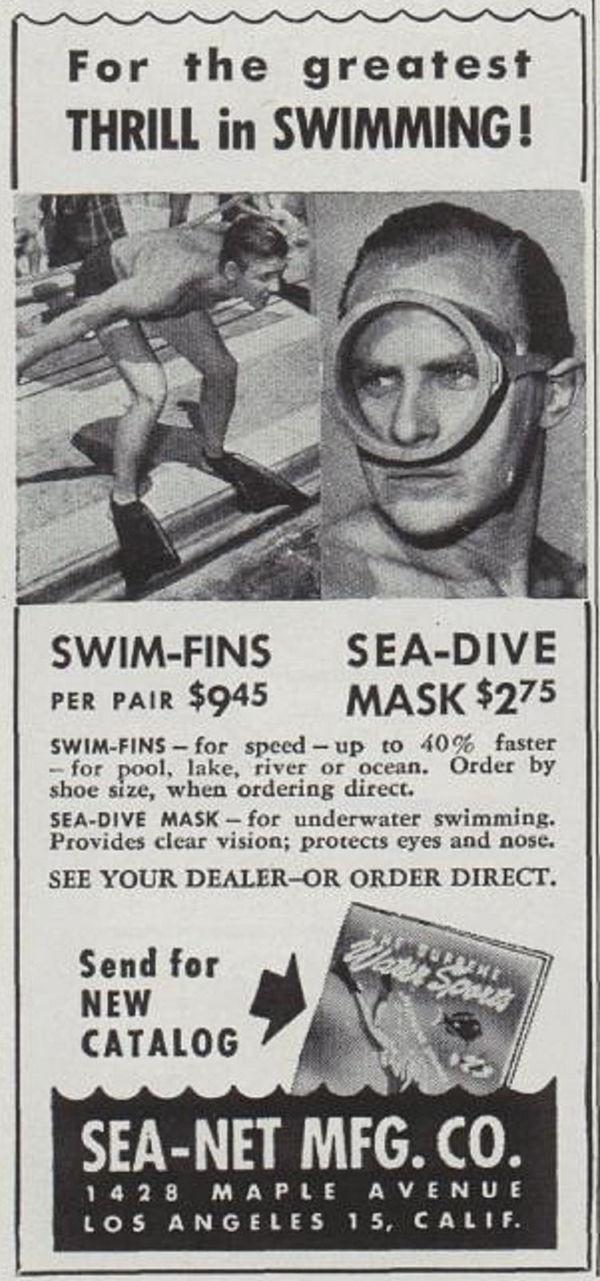
fig. 126 |
As previously mentioned, the fins supplied to the UDTs were those produced by Owen Churchill, a rather unusual character. In his youth, Churchill had participated in several Olympic Games as a sailor of the US team. In 1938, he signed a contract with Commander De Corlieu to produce and distribute his fins on license. During the production phase of these equipment, he refined the original design and patented his own fins, which were made entirely of rubber and had sturdy lateral ribs (see Figs. 127 and 128).
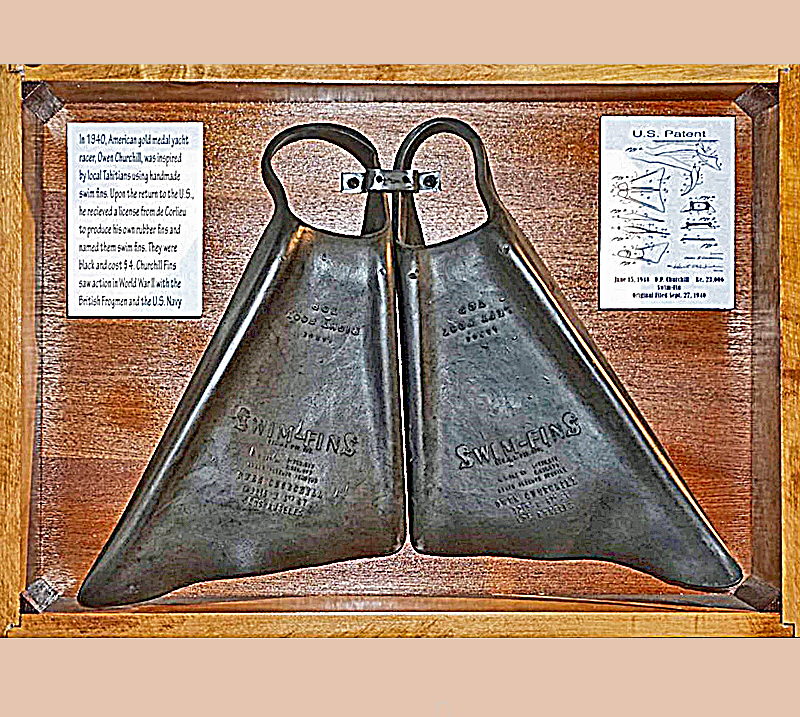
fig. 127 |
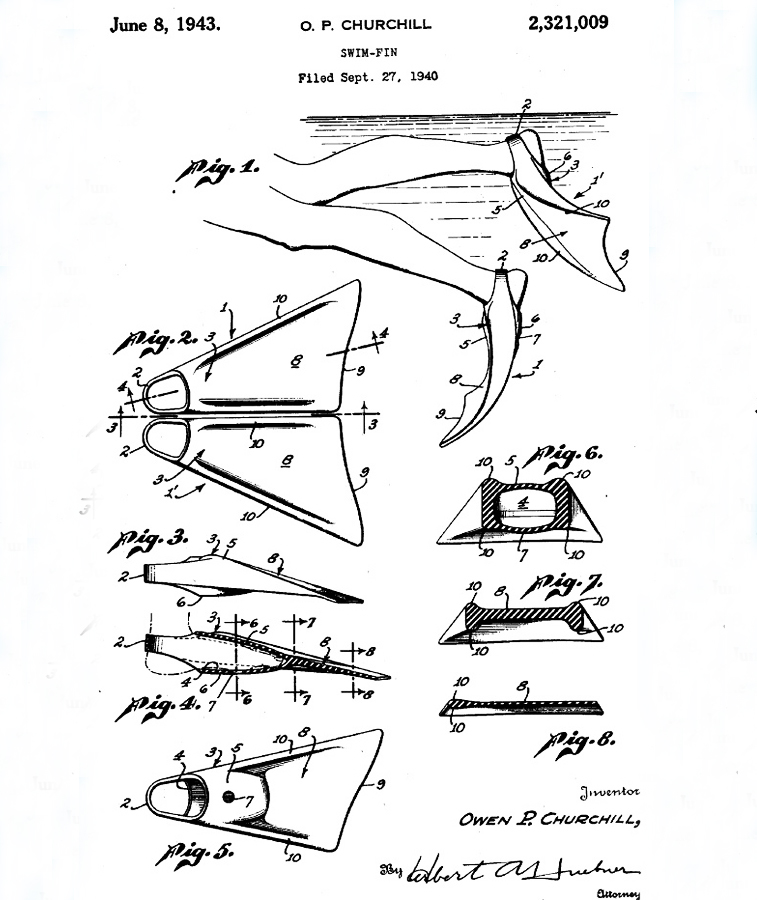
fig. 128 |
By 1940, it had sold only 946 pairs of fins to the few divers and lifeguards on the California coast. But the demands of the Second World War quickly changed the game, and in fact the US Navy ordered 50,000 pairs of fins in 1943, and an unspecified quantity was also ordered by the British Royal Navy. After the war, these fins were manufactured and distributed by the Voit Rubber Company, a division of the American Machine and Foundry Company (AMF).
The Owen Churchill fins were literally copied by many other manufacturers, primarily European, who were able to supply their models to their navies even before the end of the war (see the English Dunlop and the Italian Superga).
In the movie's footage the reconstruction of the equipment used, the deployment of operators off the enemy coast, the detection and demolition of enemy obstacles and underwater installations, and finally the recovery of the frogmen at the end of the mission, is achieved in great details and is historically accurate. In addition to the basic equipment described above, the American frogmen were equipped with a compass (with a built-in capillary-type depth gauge), a dive watch, and a plastic slate with a pencil for recording information regarding the type, location, and depth of the obstacle to be eliminated (see Figs. 129 and 130).
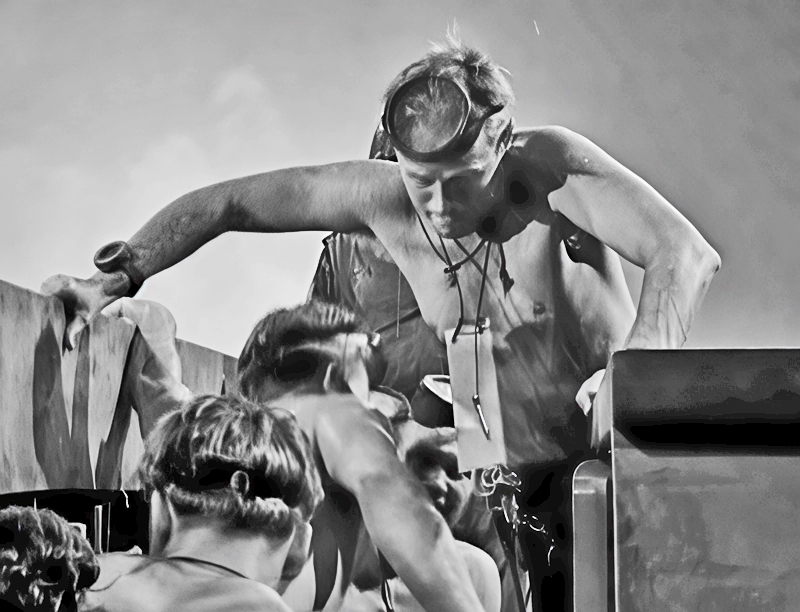
fig. 129 |
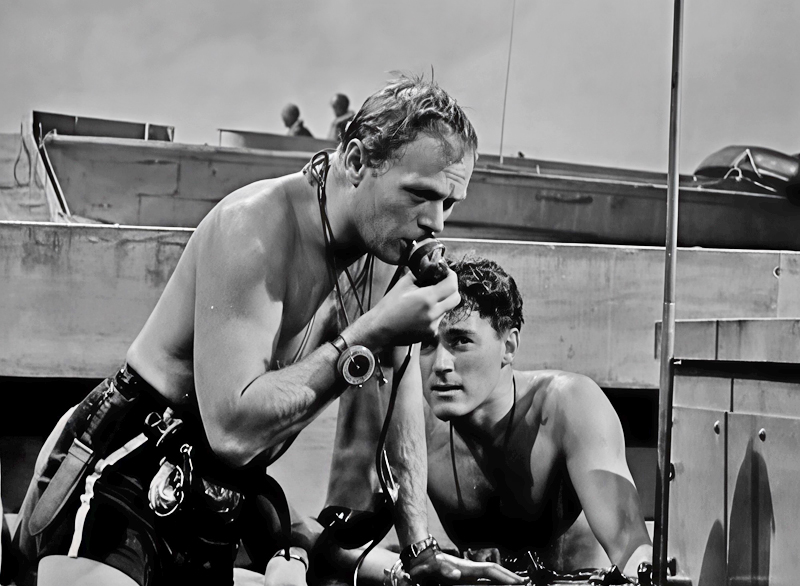
fig. 130 |
The frogmen were launched off the enemy coast using a fast boat equipped with a small inflatable raft, positioned laterally, and used to transfer the operators into the water (see Fig. 131). The individual frogmen dived at regular intervals to ensure uniform coverage of the coast being surveyed. The recovery phase at the end of the mission was similar. In this case, a sturdy rope equipped with a kind of noose was used, which the operator would hold onto as the boat passed, allowing him to be extracted from the water in a matter of seconds (see Fig. 132).
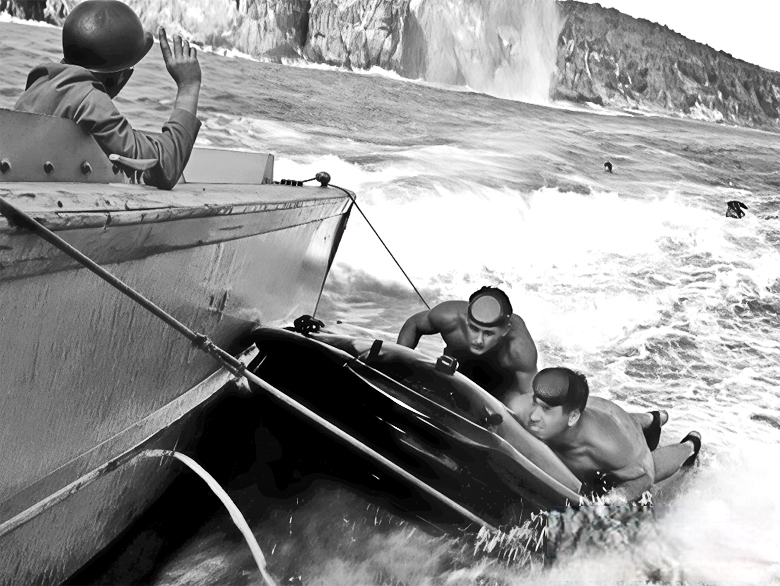
fig. 131 |
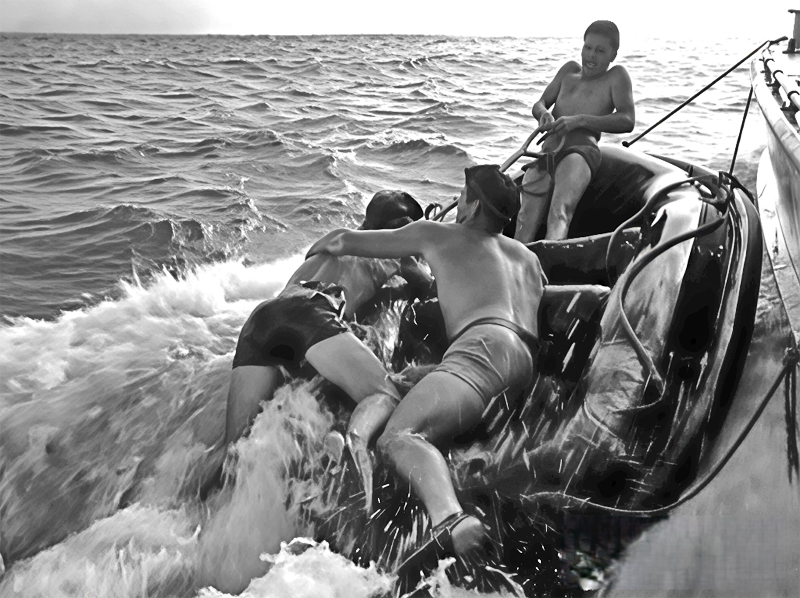
fig. 132 |
The obstacles observation and survey phase off the enemy coast is also very well described in the movie (see Fig. 133). In addition to using the slates described before to record basic information about defensive installations (see Fig. 134), the diver was also equipped with a simple manual sounder, consisting of a marked line and a small weight. This equipment was used to detect the depth of the seabed (see Fig. 135). This information was also very useful for correctly planning the landing operations of amphibious and armored vessels.
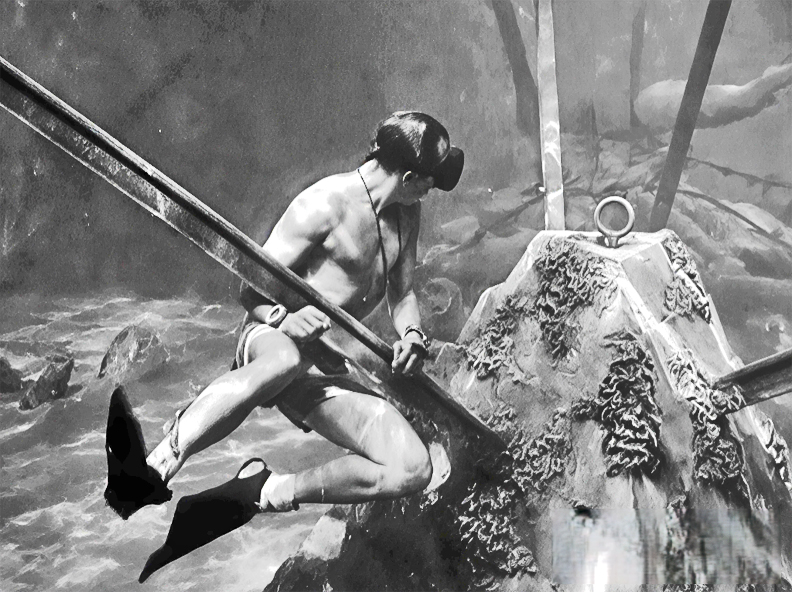
fig. 133 |
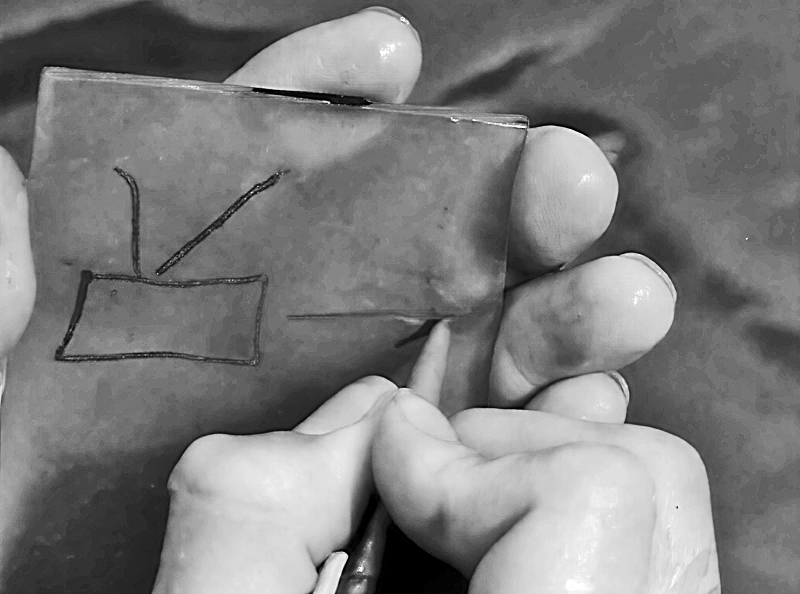
fig. 134 |
The final scene of the movie is entirely fictional, both in terms of the type of action and the underwater equipment used. The mission's objective is to attack a Japanese submarine base and blow up its main installations. There is no evidence that American UDTs were ever used in this type of attack mission against Japanese bases during the war. Indeed, since suitable underwater equipment for this type of mission did not exist at the time, the movie's producers decided to use open-circuit Scuba units to equip the American frogmen during the shooting (see Fig. 136). We know well that this type of equipment was only introduced onto the market in France in 1946 and not before 1948 in the USA, that is, after the war ended.
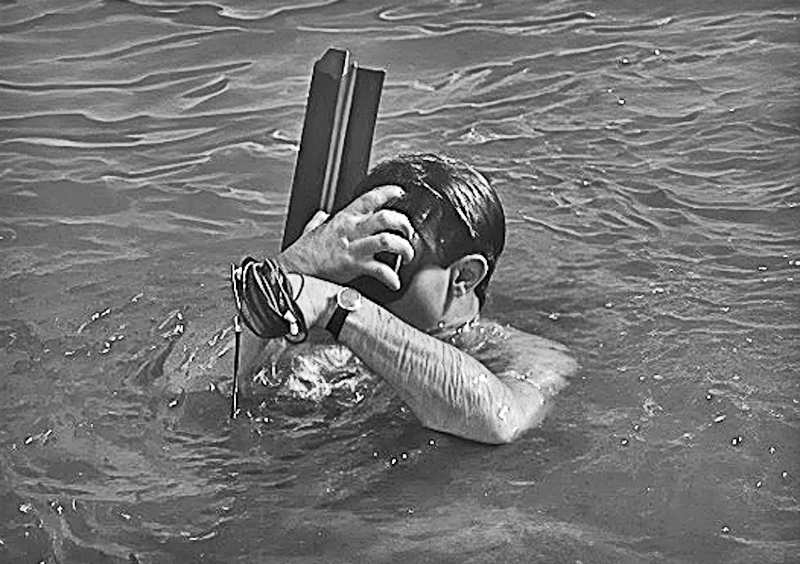
fig. 135 |
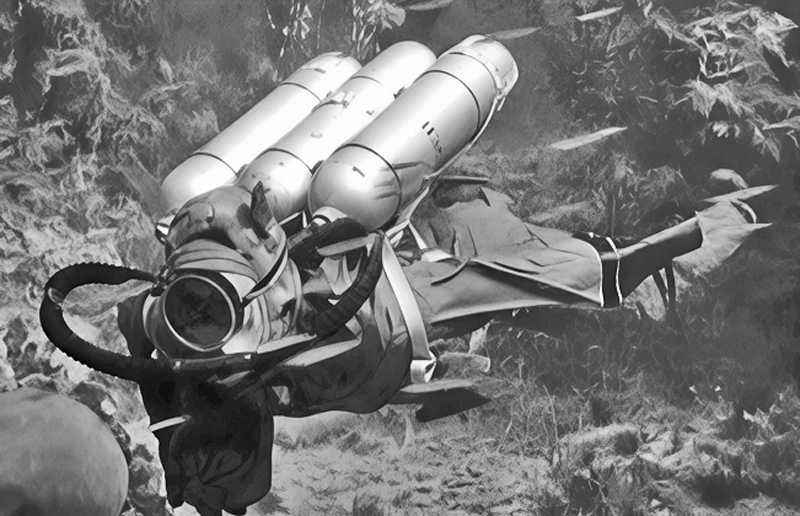
fig. 136 |
Even the equipment of the Japanese divers, who in the movie engage in underwater duels to the death with American frogmen (see Figs. 137 and 138), is entirely fanciful. Moreover, there is no evidence that the Japanese ever developed a military frogmen organization during the war.
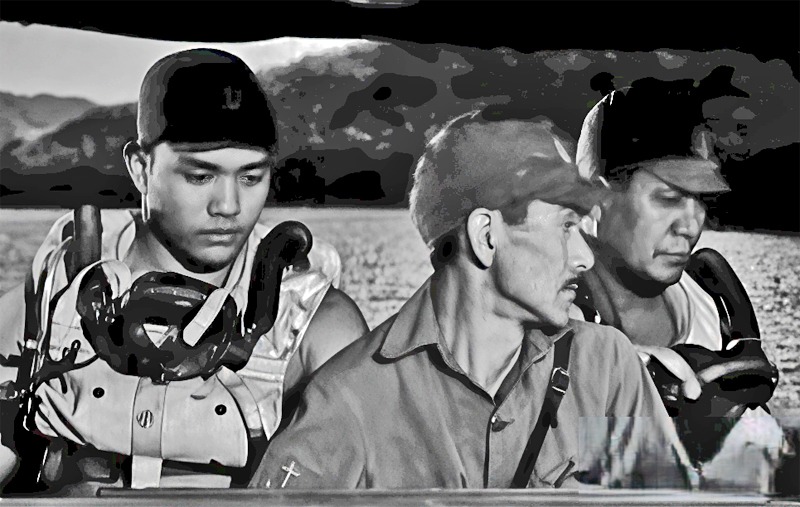
fig. 137 |
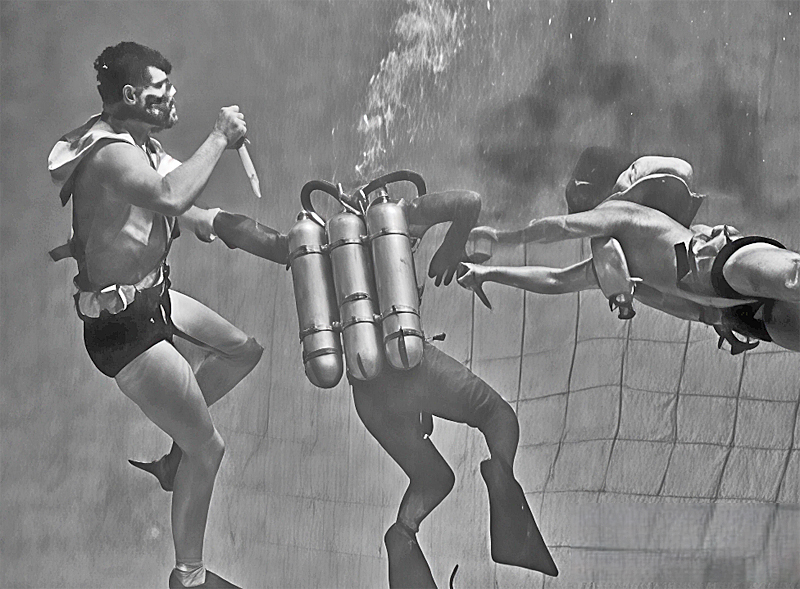
fig. 138 |
Since the movie was shot in the early 1950s, a period when there were no companies capable of producing this type of equipment in the US, the Scuba units used by the American frogmen were likely manufactured in Canada by Canadian Liquid Air Co. LTD, a subsidiary of the French group Air Liquide. These were Aqualung Scuba sets with three tanks and a textile harness (see Fig. 139).
The Japanese divers, on the other hand, were equipped with model "B" oxygen rebreathers, produced by Desco of Milwaukee, Illinois, for the US Navy starting in 1944 (see Figs. 140 and 141).
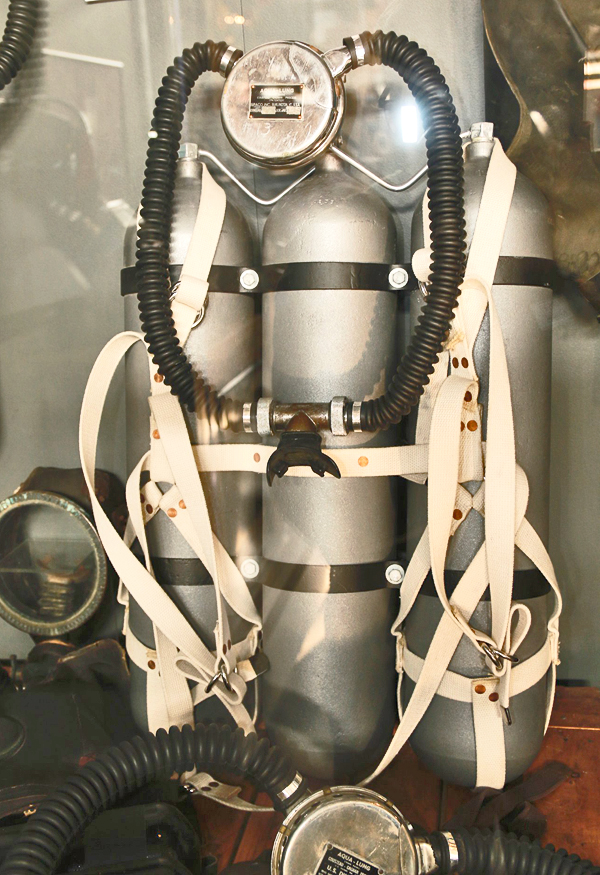
fig. 139 |
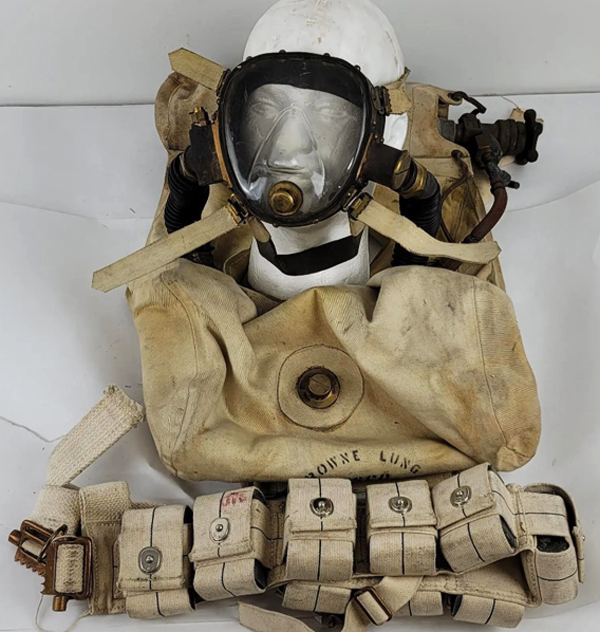
fig. 140 |
The same model of oxygen rebreather also appears on the cover of the October 1945 issue of the famous “Popular Mechanics” magazine (see Fig. 142).
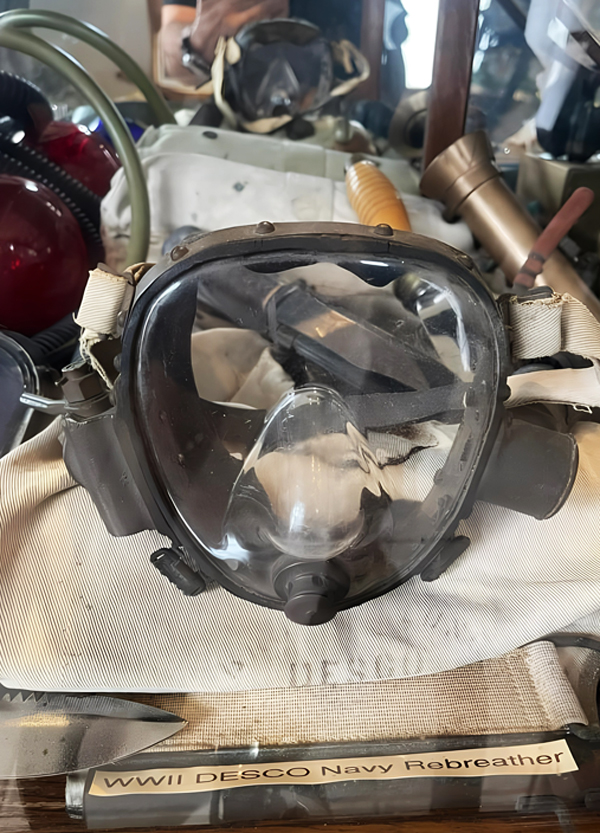
fig. 141 |
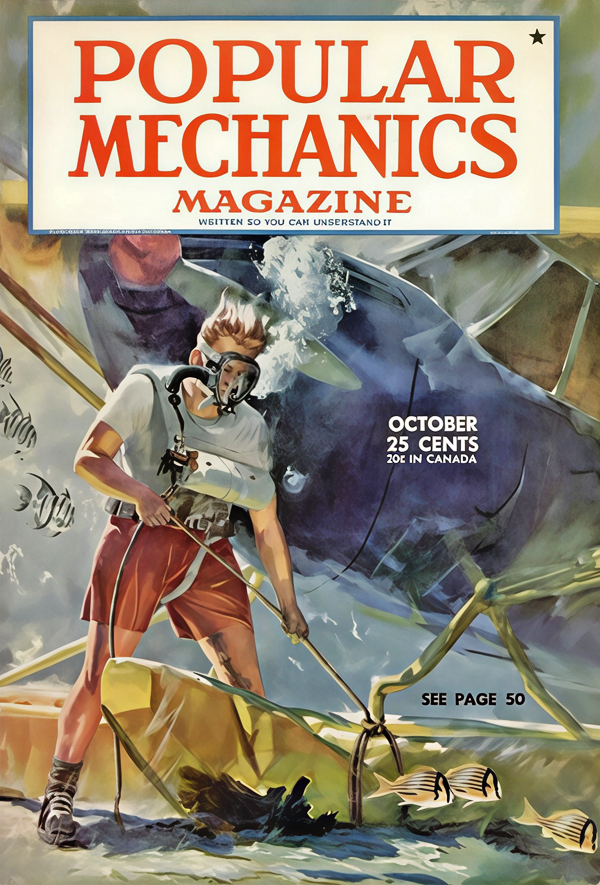
fig. 142 |
The next movie was chosen because it shows the use of the Momsen Lung breathing apparatus, a type of equipment developed by the US Navy in the early 1930s for the evacuation and rescue of submarine crews when they were stranded on the seabed due to malfunctions or damage occurred during combat. The movie in question is titled "Inferno sul Fondo" in Italian (see Fig. 143) and "Torpedo Run" in English (see Fig. 144). The work, produced by the American company Metro-Goldwyn-Mayer, was released in 1958 and was directed by Joseph Pevney. The actors chosen to play the main roles were Glenn Ford (Lieutenant Barney Doyle), Ernest Borgnine (Lieutenant Archer 'Archie' Sloan), Robert Hardy (Lieutenant Redley), Paul Picerni (Fisher), Dean Jones (Foley), Don Keefer (Millingan), and Richard Carlyle (Adams).
It's the story of a US Navy submarine during missions against the Japanese during the Second World War. Commander Doyle of the US Navy submarine Greyfish is searching for the Japanese aircraft carrier Shinaru, which was part of the fleet that launched the devastating attack on Pearl Harbor. But his desire for revenge is dashed by the news that alongside the Japanese vessel is a merchant ship carrying prisoners to Japan, including his wife and daughter, and that the ship is being used as a shield against torpedo attacks by US Navy submarines. Doyle decides to attempt the attack anyway, but one of his torpedoes hits the merchant ship, causing it to sink with the inevitable loss of his family. Deeply affected by this personal tragedy, Doyle nevertheless decides to follow the aircraft carrier into the enemy harbor and, after various attempts, finally manages to sink it, even though this feat ultimately costs him the loss of his submarine.
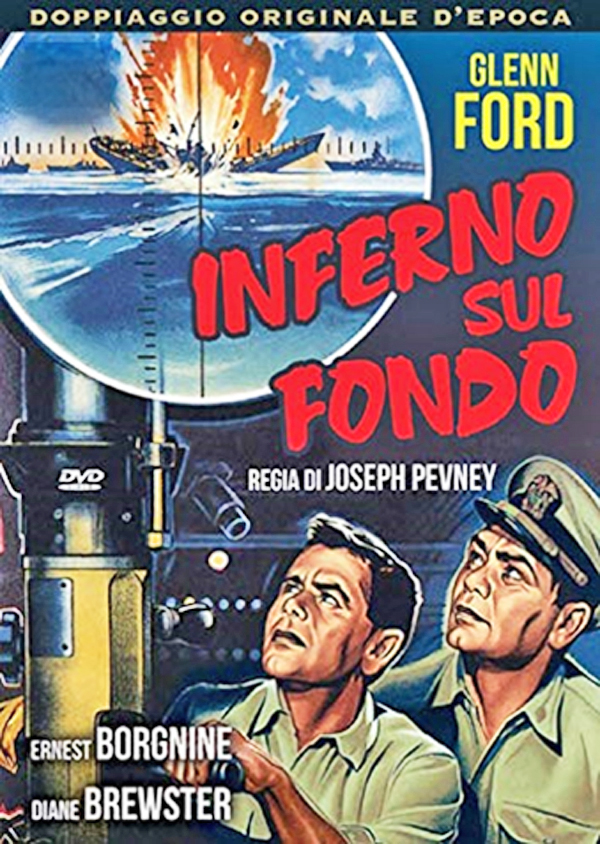
fig. 143 |
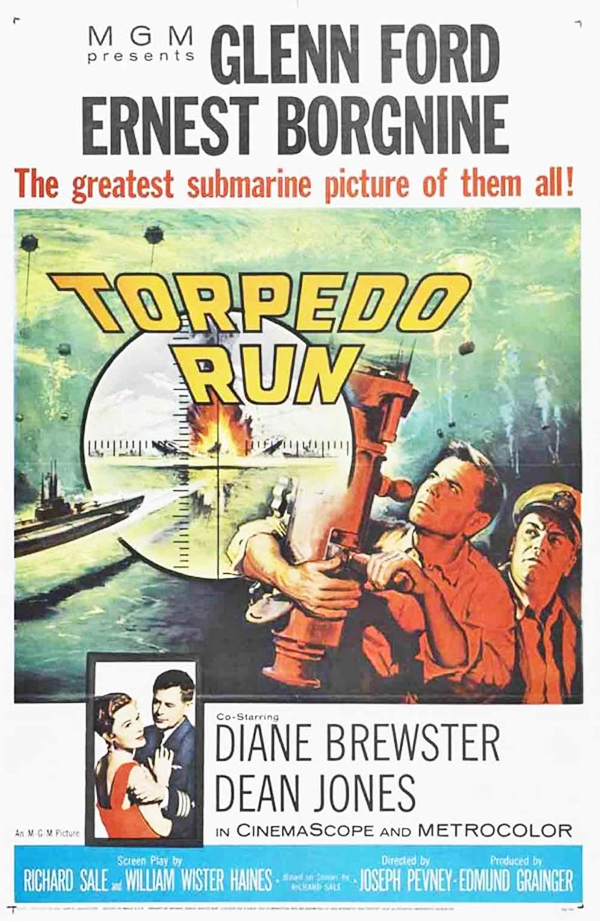
fig. 144 |
In the final scenes of the movie, in which the Greyfish crew manages to escape the submarine and ultimately save themselves, the Momsen Lung is used, a self-contained breathing apparatus invented by US Navy officer Charles Momsen in the early 1930s and subsequently improved and used on US Navy submarines during the Second World War (see Fig. 145). It was a device that could operate with either oxygen or air, depending on the depth at which the damaged submarine was located. Unlike other similar systems, the Momsen Lung had no compressed gas tanks or other internal sources but could rely only on the amount of gas injected into its breathing bag by the crew members immediately before the underwater evacuation.
It was equipped with a small canister containing soda lime to eliminate carbon dioxide from the breathing gas and a mouthpiece with a two-way valve and a coaxial metal duct for the breathing inhale and exhale gas flows. It was therefore effectively a closed-circuit cyclic type breathing system. The preparation and evacuation phases from the submarine are well described in the movie, including the procedure for loading the rebreathers using oxygen or compressed air drawn from the submarine's pneumatic systems (see Figs. 146 and 147).
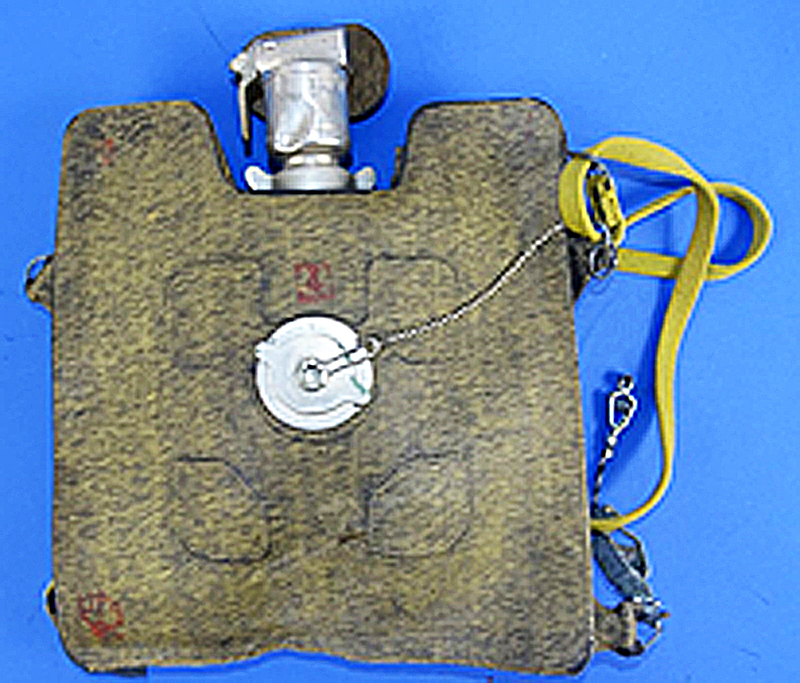
fig. 145 |
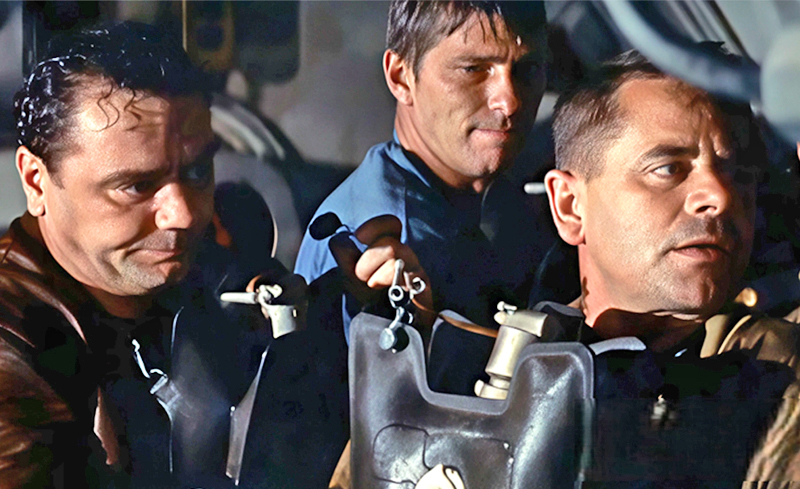
fig. 146 |
Glenn Ford himself, the main actor in this movie, did not shy away from underwater shooting, even challenging ones, without the use of stuntmen (see Fig. 148).
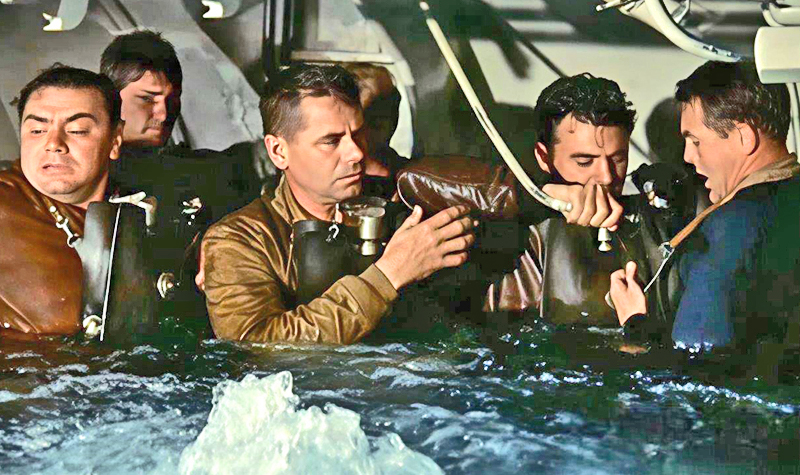
fig. 147 |
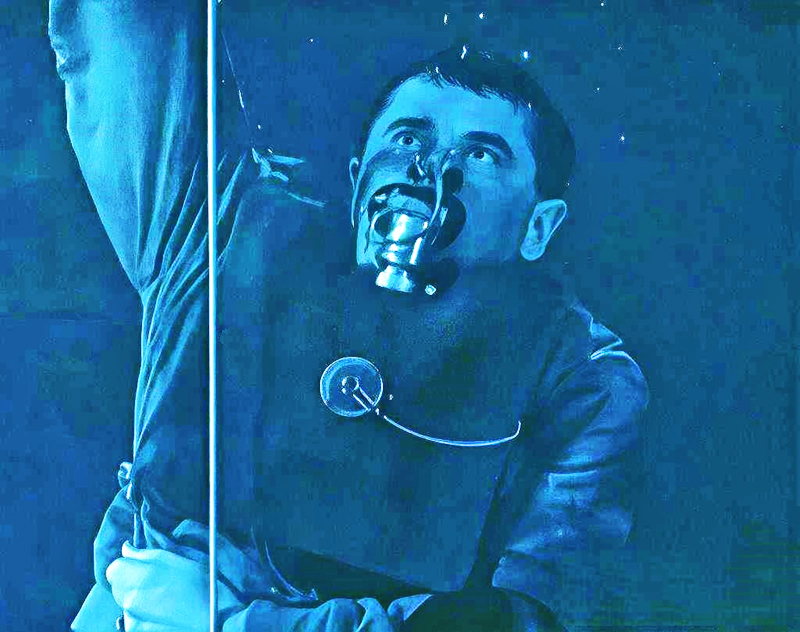
fig. 148 |
Comparing these sequences with those of a 1953 educational/promotional documentary produced by the US Navy and available on YouTube, I noticed that one piece of the submarine rescue equipment, of which the Momsen Lung was the main element, was not used in the shooting. These were the special goggles shown in Fig. 149. These goggles, as explained in the US Navy movie, was designed for the two purposes described below:
- to protect the eyes of the operators inside the submarine (see Fig. 150) in the presence of chlorine vapors, often emitted by the submarine's electrical batteries when flooded by seawater. These vapors, in addition to being extremely poisonous when inhaled, were also highly irritating to the eyes
- to allow operator’s good vision even during the underwater ascending phase to the surface (see Figs. 151 and 152). The special valve located in the central upper part of the goggles had to be closed before starting the evacuation underwater phase
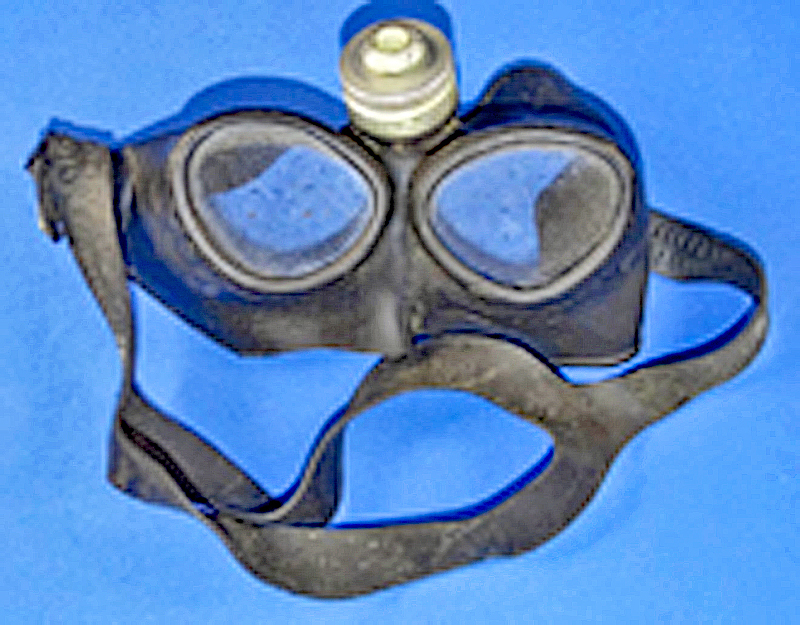
fig. 149 |
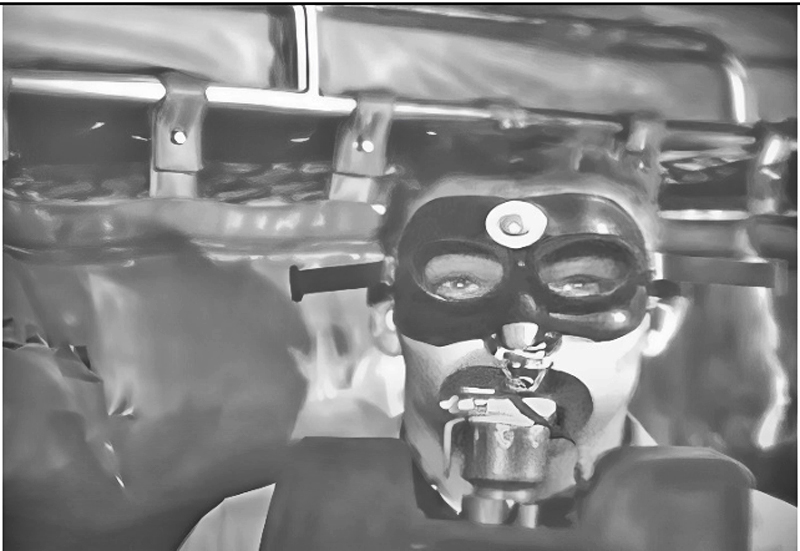
fig. 150 |
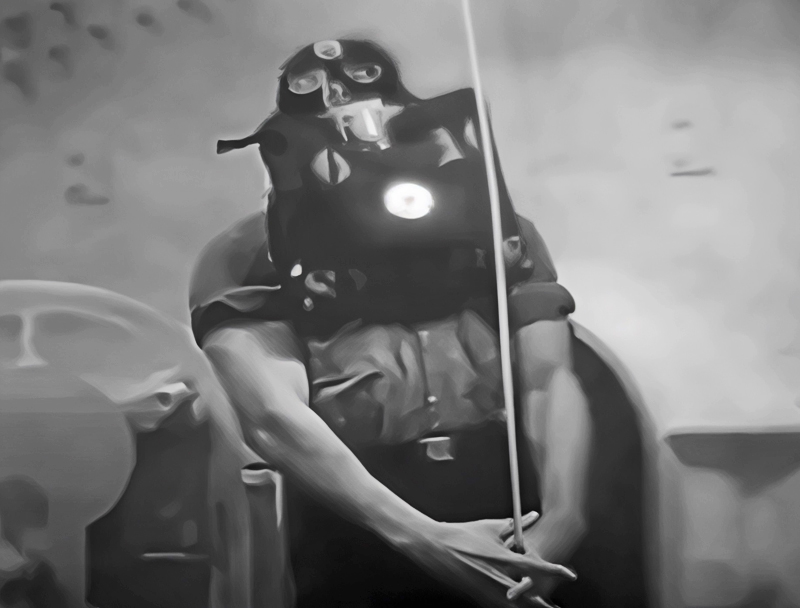
fig. 151 |
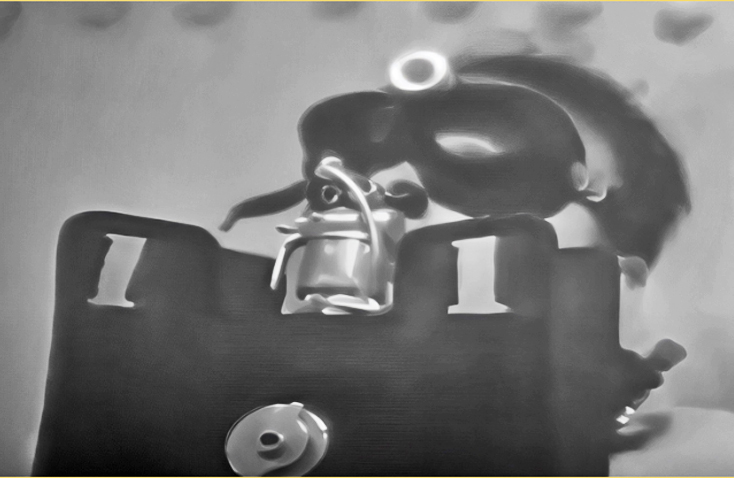
fig. 152 |
The decision not to use these goggles in the shooting was likely due to the need for better visibility of the actors' facial expressions during these highly dramatic scenes.
The last cinema work dedicated to the achievements of American frogmen during the Second World War, which we will examine, is “Quota Periscopio!” (see Fig. 153), an American color film produced in 1959 and originally titled "Up Periscope" (see Fig. 154).
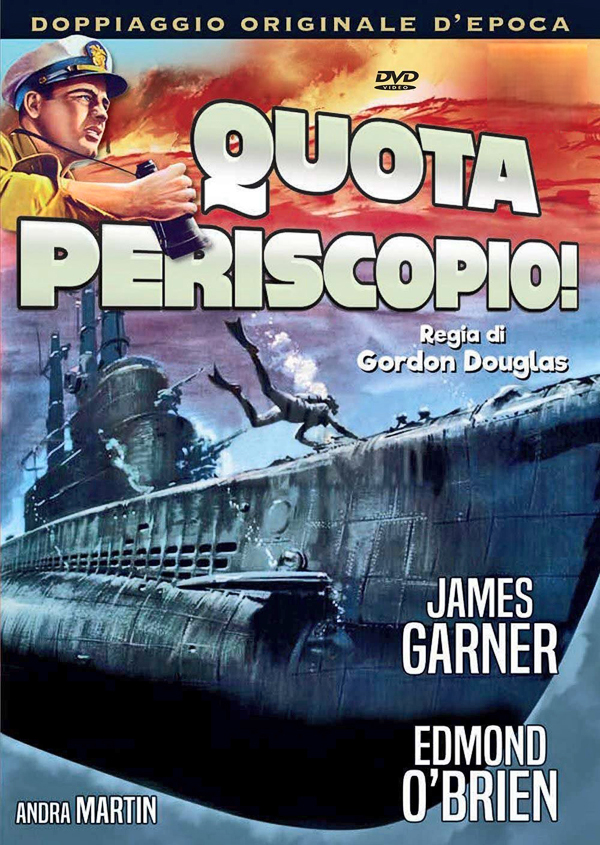
fig. 153 |
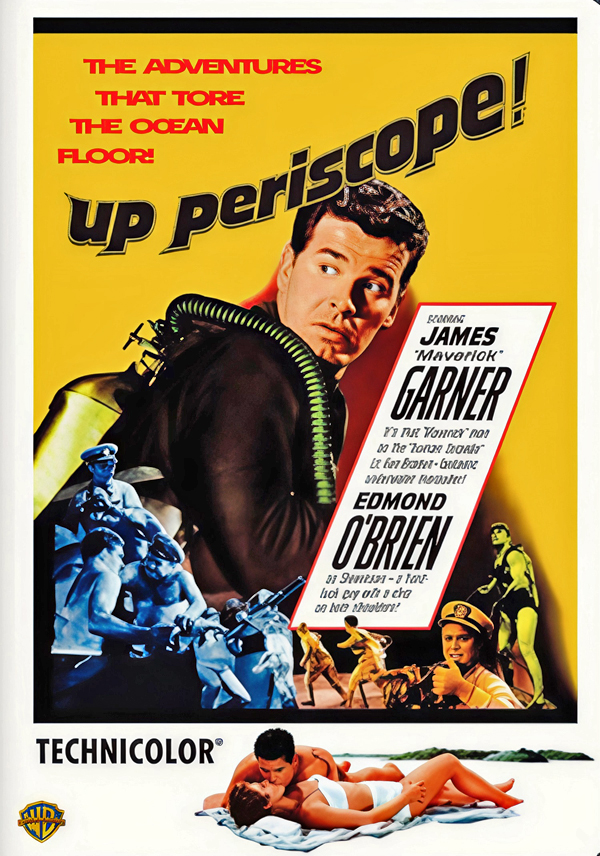
fig. 154 |
The movie is directed by Gordon Douglas, and the main cast includes James Garner (Lieutenant Kenneth M. Braden), Edmond O'Brien (Commander Paul Stevenson), Andra Martin (Sally Johnson), Alan Hale Jr. (Lieutenant Pat Malone), Carleton Carpenter (Lieutenant Phil Carney), Frank Gifford (Ensign Cy Mount), William Leslie (Lieutenant Doherty), Richard Bakalyan (Seaman Peck), Edd Byrnes (Mate Ash), and Sean Garrison (Seaman Floyd). The subject of the movie m is as follows: Lieutenant Braden, a US Navy frogman, is ordered to reach Pearl Harbor for an important mission. He must board a submarine and then reach Kosrae, a Japanese naval base, infiltrate it, and finally obtain the secret code used in the enemy fleet's radio transmissions. During the long approach, the submarine is attacked several times by the Japanese. Despite some casualties and various damages, the objective is achieved. After reaching the enemy coast, thanks to the use of scuba equipment, the frogman emerges from the submerged submarine and manages to penetrate inside the Japanese base.
Aided by luck, he completes the mission and returns safely aboard the submarine. The commander, violating safety regulations and putting the entire crew at risk, has decided to await his return, hiding on the bottom of the enemy bay.
In the images extracted from the movie and shown in Figs. 155, 156, 157 and 158, we can see the main equipment used by the American frogman during his mission. Again, this equipment is completely unrealistic and was chosen not based on what was actually available during the war, but rather on the availability of materials during the movie's production period. It cannot be ruled out that the use of certain equipment was agreed upon between the producers and certain diving gear manufacturing companies. The latter were often willing to provide these materials free of charge in exchange for the advertising that viewing the movie could generate. As already stated for some of the works analyzed previously, the use of an open circuit Scuba unit during the Second World War is a historical falsehood both for temporal reasons (the Scuba did not yet exist) and for performance reasons, as this device was not compatible with the concealment needs of the navy commandos.
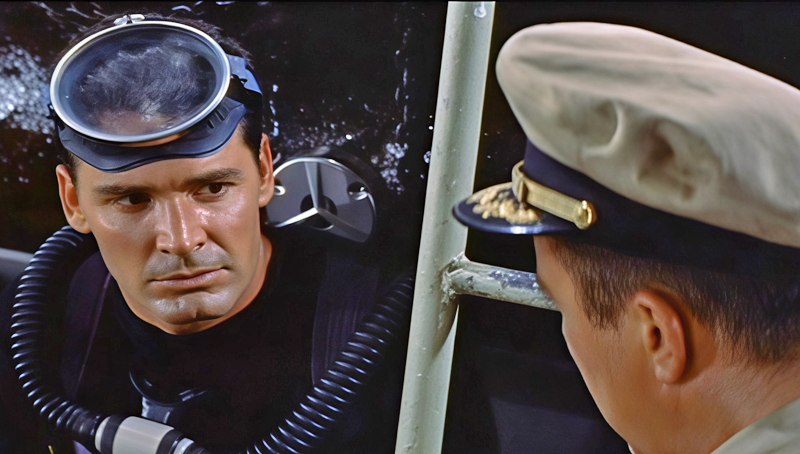
fig. 155 |
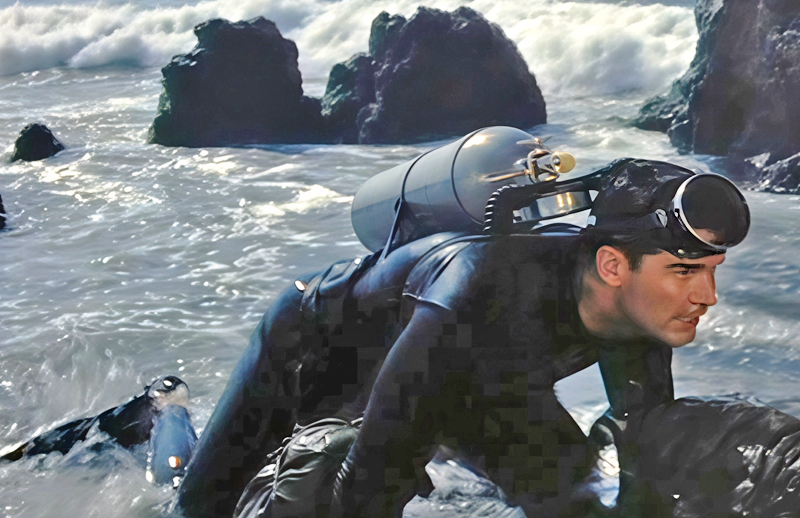
fig. 156 |
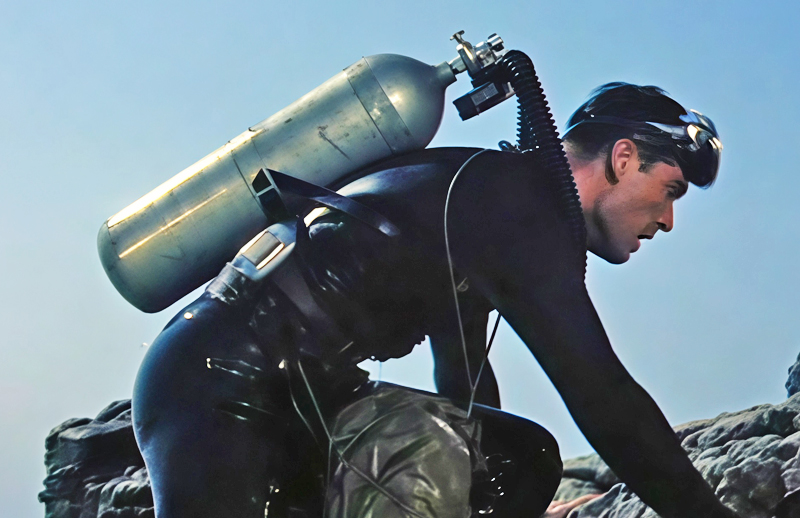
fig. 157 |
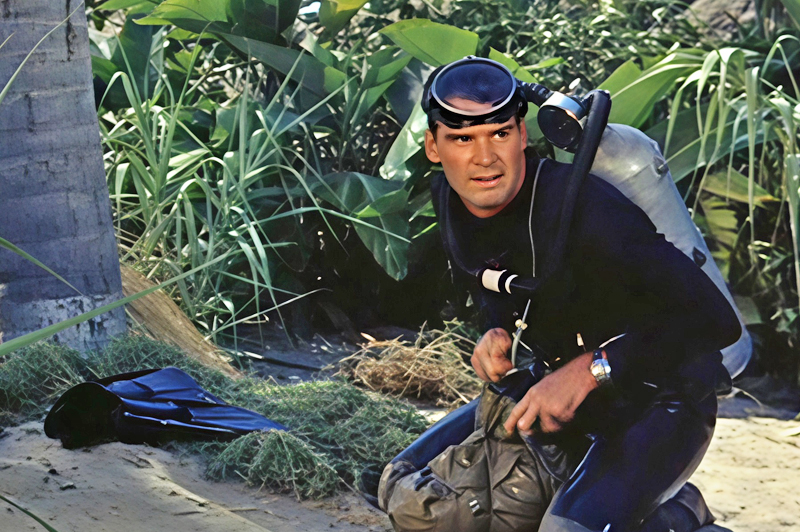
fig. 158 |
Of all the equipment worn by the American frogman, we selected two items: the regulator and the mask. The fins are not clearly visible in the underwater scenes, and the wetsuit was made by neoprene model, material that had been used for such purpose since the early 1950s.
The regulator used in the shooting was a “Divair” model "F", manufactured by the L. G. Arpin Company of West Caldwell, New Jersey, starting in 1954 and subsequently distributed by California-based company Healthways (see Figs. 159 and 160). This was one of the first open-circuit Scuba devices designed and built in the USA, competing with the Aqualung, a model derived from the famous Cousteau-Gagnan self-contained breathing apparatus and later produced for the North America market by U.S. Divers (a company later acquired by the French company La Spirotechnique). The “Divair” was equipped with a special high-performance mouthpiece, the “Hope-Page” with one-way valves and regulation which was designed by Rory Page.
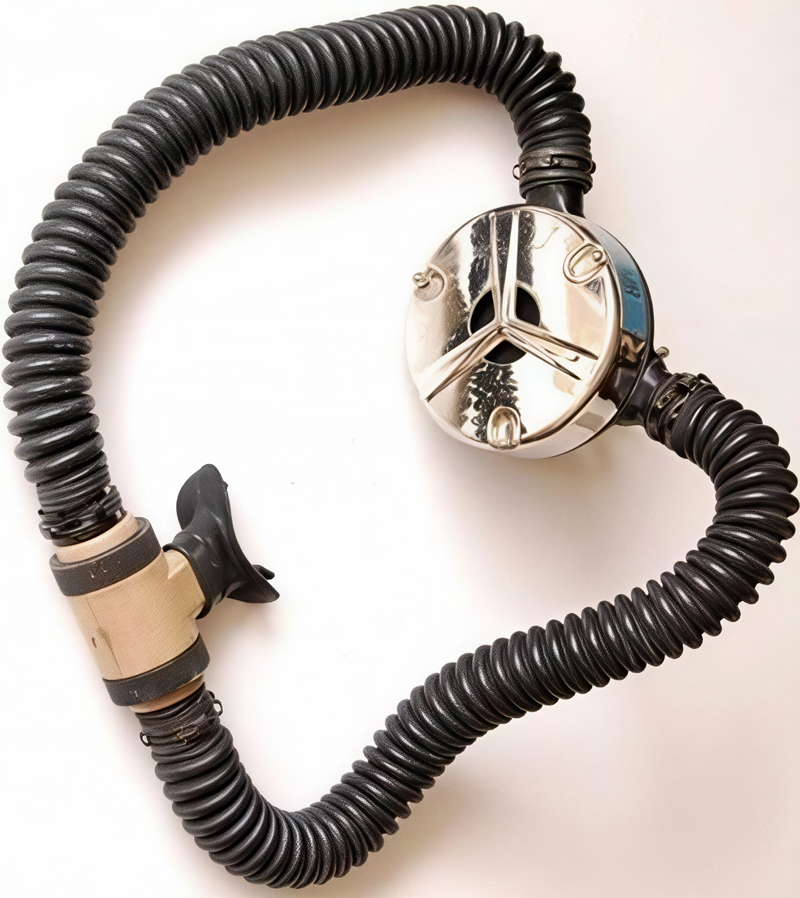
fig. 159 |
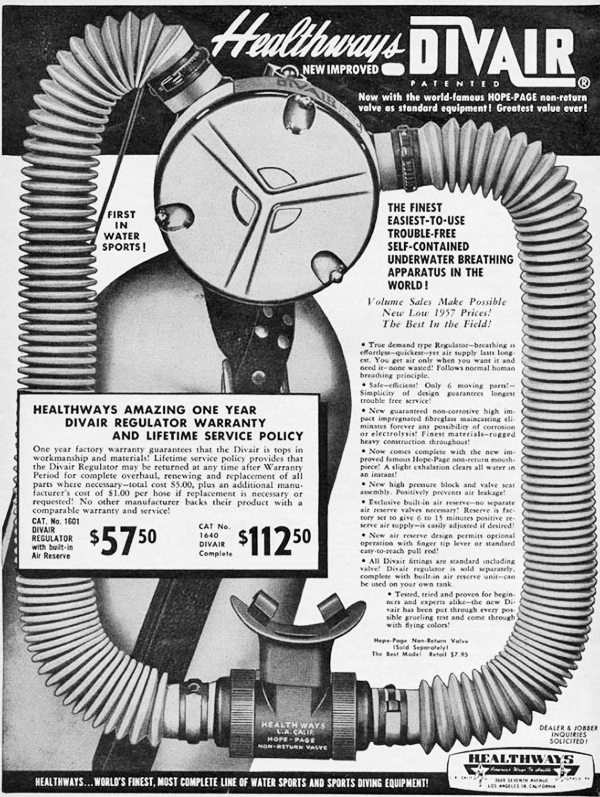
fig. 160 |
The mask used by Braden in the movie was the “B4” model manufactured by the Voit Rubber Corporation. This mask (see Fig. 161), along with other scuba equipment, would later become famous because it was used by Mike Nelson (see Fig. 162), played by actor Lloyd Bridges and the star of the popular television series “Sea Hunt”. This 155-episode series released in the USA from 1958 to 1961 and served as an extraordinary advertising campaign for the entire recreational scuba industry.
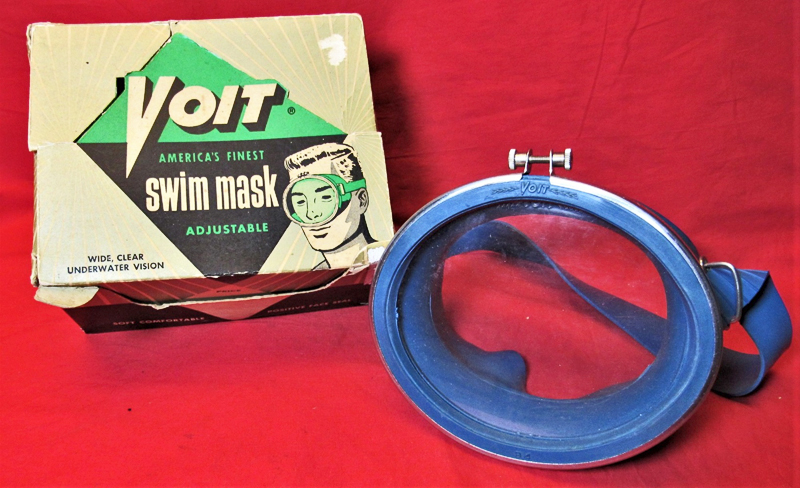
fig.161 |
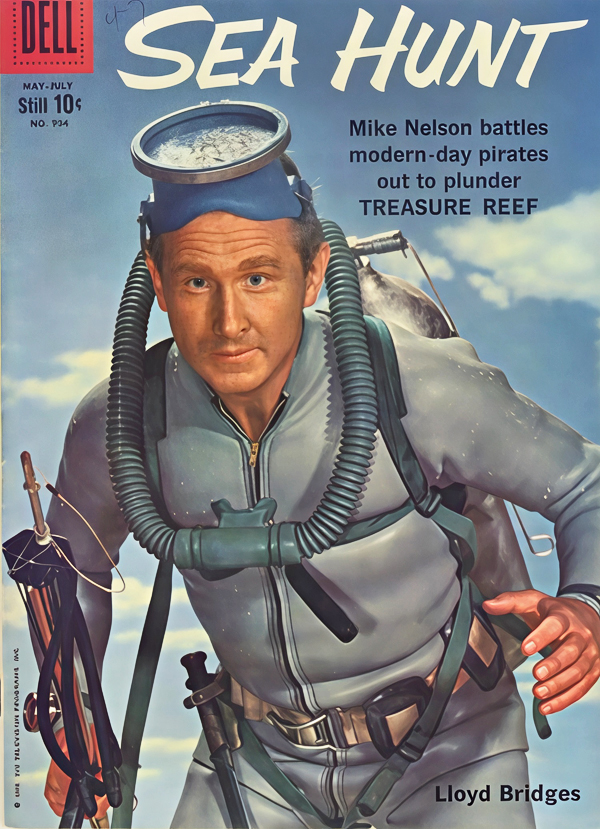
fig. 162 |
This overview of the cinema works dedicated to the achievements of military navy frogmen during the Second World War and the most important underwater equipment used during the shooting of these movies ends here. It also provided an opportunity to recall the major wartime events in which these courageous men participated, often defying overwhelming enemies and sometimes even sacrificing their freedom and their lives.
––––––––––